Surrender
20 articles

Signs from the Universe: How to Listen When Life Is Speaking to You
I want to tell you about two things that happened to me recently. By any objective measure, neither of them is remarkable. One involved a car. The other involved chewing gum.
More tagged “Surrender”

Meditation Myths Debunked: How to Actually Begin (Or Begin Again)
I have lost count of how many people have told me they can't meditate. Sometimes they say it with a kind of proud resignation, I've tried, I'm just not that kind of person. Sometimes, with a frustration that suggests they genuinely wanted it to work. Sometimes with a faint embarrassment, as though they've failed at something that seems to come easily to everyone else.

Sanctuaries of the Self: Finding Rhythm and Ritual on the Road
Travel has a way of unravelling us. It stretches our boundaries and expands our horizons, but in the movement, we often lose the steady pulse of our daily rituals. After eight months on the road, I’ve realised that protecting your practice isn’t about rigid adherence to a schedule; it’s about finding the spaces that help you return to yourself—the ones that feel less like a workout and more like medicine.

The Yogic Path of Remembering: Seeing Beyond Samskaras and Old Narratives
There are moments in life when you realise that what you are reacting to is not the situation in front of you, but the echo of something much older.A familiar sting.A tightening in the chest.A story your body remembers even if your mind has forgotten its origin.

Life Lessons in Your 30s: Wellness, Growth, and Finding Yourself Beyond the Surface
A reflection on wellness, wholeness, and the quiet lessons that keep arriving. Your thirties are a middle ground, old enough to know better, young enough to still test the edges. Somewhere between who you thought you’d be and who you’re becoming, life starts to whisper its truths. This is the decade when awareness deepens, priorities shift, and the surface begins to crack in the best possible way.

Meditations as Portals: Shifting the Mind, Soothing the Body
We spend much of our lives replaying the past, thoughts become familiar, feelings become habitual, and the body begins to live in cycles of memory. What feels like “just the way things are” is often simply a loop of remembered emotions.

Beyond the Past: Rewriting the Stories We Live By
There comes a time when we begin to notice that the patterns repeating in our lives are not coincidences; they are mirrors. The way we love, react, protect ourselves, and withdraw often stems from stories we didn’t consciously choose. They are scripts written by earlier versions of ourselves, shaped by our experiences, emotions, and beliefs.

Learning to Trust Through Love
We often speak of love as something we either have or don’t, something we fall into or out of. Yet few of us pause long enough to consider its deeper purpose. What if love is not the destination, but the lesson itself?
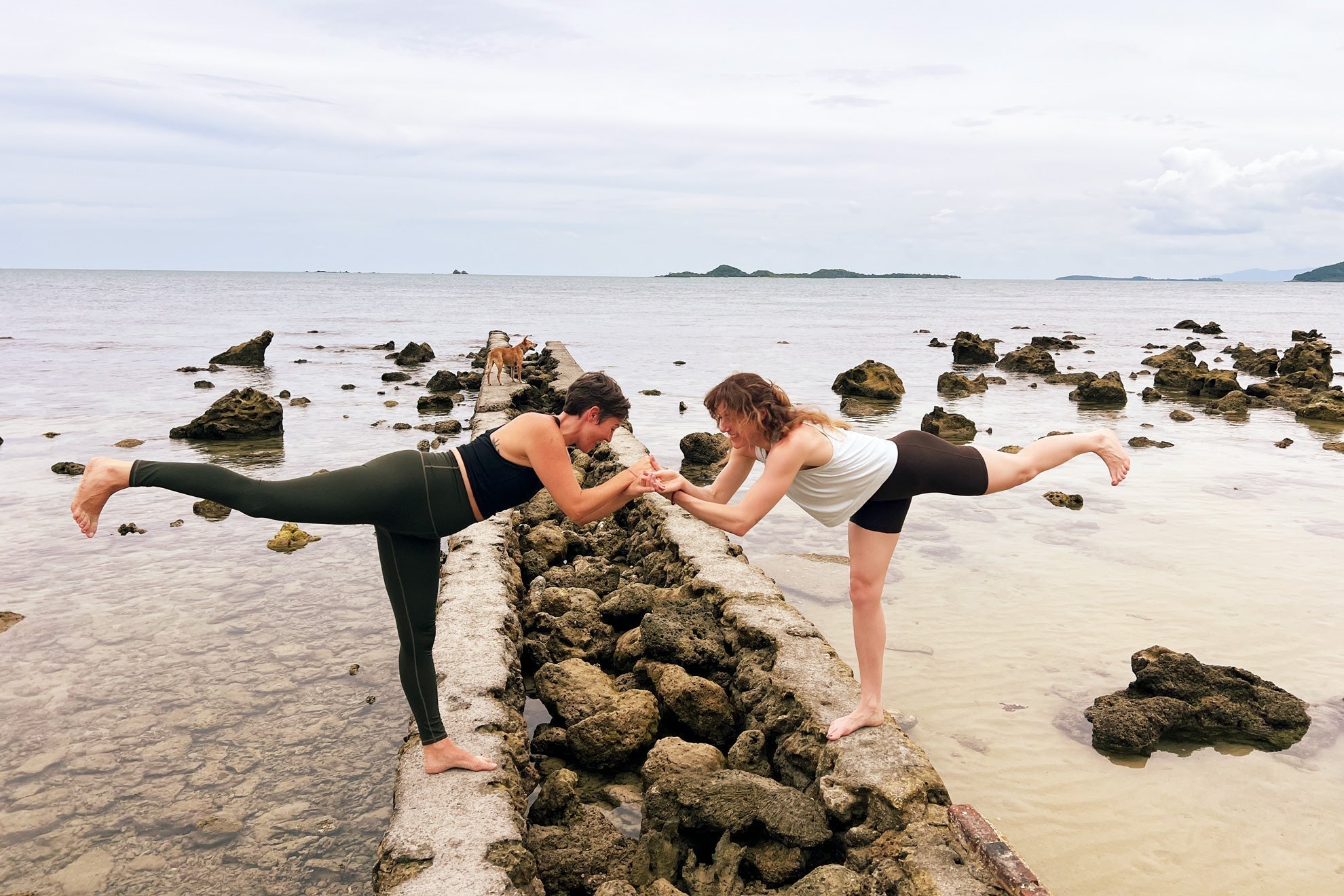
Chance Encounters That Change You: How Travel Brings the Right People Into Your Life
There are people in our lives who remind us to play; the ones who make you want to cartwheel on the beach, run along the sand, or balance, laughing, in a rock pool in warrior three. On my Koh Samui retreat, there was one such person: Bronte.
When People Show Up: Embracing Divine Timing and Connection
In the tapestry of our lives, certain individuals appear at pivotal moments, their presence seemingly orchestrated by forces beyond our comprehension. These encounters often feel serendipitous, yet within the framework of yogic philosophy, they are seen as manifestations of divine timing, guiding us toward growth and self-realisation.

The Light We See in Others: A Story of Gratitude and Human Connection
There are moments in life when we meet people who feel like mirrors. All the qualities we long to recognise in ourselves appear so effortlessly in them. And then, as you spend time together, you realise something extraordinary: what you see in them is what they see in you. The connection becomes something rare and beautiful — a space where you bring out the best in one another, even though just days before you were strangers.

Yoga as a Framework for Wholeness
Yoga has always been more than movement. Long before it became a practice of postures, it was described in the ancient texts as a complete framework for living with steadiness and clarity. The Yoga Sūtras of Patañjali remind us: “Yoga is the stilling of the fluctuations of the mind.” (Yoga Sūtras I.2)

Everyday Moments That Are Yoga (Without You Realising)
Yoga is often thought of as postures on a mat or quiet studio time. Yet the ancient texts describe it far more broadly, as a framework for cultivating steadiness, awareness, and presence in every aspect of life. The Yoga Sūtras tell us:
The Multi-Dimensions of Wellness Part 2: A Gentle Guide to Living Well

On Retreat with Your Yoga Teacher: A Journey Back to Yourself
I have been practising yoga for about eight years and teaching for the past eighteen months. When I finally felt it was my time to guide others along the yogic journey, I also knew that my own practice was far from finished. My curiosity and hunger for growth led me to immerse myself in three Moksha Yoga Teacher Trainings. After completing my 200-hour training in Bali in January 2024, I continued with a 110-hour Meditation Teacher training, and then dove into Yin and Sound Medicine simultaneously.

Exploring How Culture Shapes Your Experience: A Reflective Guide to Wellbeing and Place
There are places in the world that make you feel whole, grounded, and deeply nourished, and there are places that quietly take from you, chipping away at the equilibrium you’ve worked to cultivate. It can feel as though the culture of a place seeps through your skin, shaping your energy and attitude before you’ve even noticed.

When Your Environment Sets Your Limits: Rethinking Boundaries and Self-Worth
There’s something quietly profound, and often overlooked, about the boundaries and standards that shape our lives. Not always the ones we consciously set, but those gently handed down to us by the people and spaces we inhabit. Whether in work, friendships, family, or romantic relationships, these invisible lines quietly frame what feels possible, what we believe we deserve, and ultimately, how we see ourselves.

20 Reflections from The Surrender Experiment by Michael A. Singer
I read The Surrender Experiment just days after walking away from my corporate job, twelve months into the unknown. No guarantees, no structured plan. Just a quiet knowing that something had shifted.

20 Moments from The Untethered Soul by Michael A. Singer
A journey inward to awareness, stillness and freedom. Some books arrive like whispers. Others arrive as gifts. For me, The Untethered Soul was both.

The Multi-Dimensions Of Wellness Part 1: Understanding the Whole of Who We Are
Living a wholesome life with good stable mental health is what we all dream of, isn’t it? Why is it that when you google wellness or well-being you are met with long-form complicated articles, fluffy images with soft pink colours or centres for massage and facial treatments? It’s no wonder we all seem so confused.